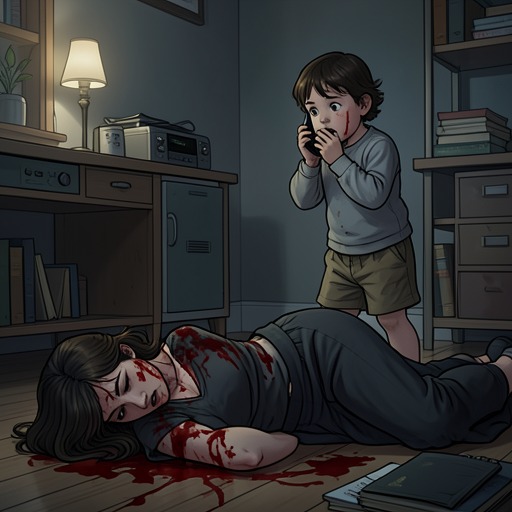
The Discovery of Y·N’s Adoption
Living with 7 vampiresThe Discovery of Y/N’s Adoption is the first decisive rupture in Y/N’s belief that the people who raised her are her biological parents. The revelation begins with an apparently private object—a closed book bearing her name—and ends with Y/N confronting the possibility that her entire family history has been concealed from her. Because the evidence comes through a written record preserved by her mother, the event is both a disclosure and a crisis of memory: Y/N does not recover her past directly, but encounters it through an artifact that her adoptive family kept out of ordinary view.
Discovery of the Book
Y/N is sixteen when she enters her parents’ room, a place she has not been inside for a long time. The room’s desk draws her attention, where she sees a closed book with words on it. The decisive detail is that Y/N’s name stands on the cover. This turns an otherwise unremarkable household object into a personal summons. The book is not merely found; it appears to have been connected to her identity before she understood that identity as incomplete.
Y/N carries the book back to her room and tries to open it, but a lock prevents access. The lock makes the discovery conditional: the truth is present, yet materially withheld. The key is supplied by the necklace her mother gave her. When Y/N examines the necklace, she realizes that it is a key and uses it to unlock the book. The necklace therefore changes status from a familial gift into an instrument of disclosure. Its origin in her mother’s hands also binds affection, secrecy, and access together in the same object.
The Diary Revelation
Once the book is opened, Y/N reads an entry dated 14 April. The writer describes returning from shopping and finding a small child lying in a basket. There is no note, and the only immediate evidence of the child’s identity is something sewn into the blanket in which the baby is wrapped. That stitched marker is Y/N’s name. The writer records choosing Y/N as the child’s name, establishing that the name was assigned after the discovery rather than necessarily inherited from biological parents.
The entry also states that the writer normally hates children but could not leave the baby outside in the cold. This detail gives the adoption account a concrete circumstance: Y/N was not presented as a child formally entrusted to the household, but as an abandoned infant encountered in danger and taken in. The record supplies no explanation of who left her there or why. It documents the adoptive parents’ first act of care while preserving the absence at the center of Y/N’s origin.
Y/N’s Immediate Crisis
The meaning of the entry reaches Y/N all at once. She asks whether it means she is not her mother’s daughter, then immediately extends the question to her unknown biological parents: who they are and why they abandoned her. Her response transforms the diary from a family record into an accusation directed at an absent past. The discovery does not provide a complete genealogy or a comforting explanation; it confirms adoption while leaving the motives, identities, and circumstances of the abandonment unresolved.
The emotional force of the event comes from the contrast between Y/N’s former assumption and the diary’s blunt material evidence. She had understood the household as the place of her origin, but the entry relocates that origin to a basket, a blanket, a cold outdoor setting, and an unnamed act of abandonment. The book consequently does more than reveal a legal or biological fact. It destabilizes Y/N’s sense of belonging and makes her own name part of the mystery, since the name was chosen by the person who found her.
A knock from Jungkook follows the revelation, with him asking whether everything is all right. The interruption places Y/N’s private shock against the continuing life of the household. She has discovered something that changes her relationship to her parents, yet the world outside the room has not visibly changed. This split between ordinary domestic routine and newly exposed secrecy becomes a defining feature of the event.
Objects, Secrecy, and Identity
The event is organized through a chain of objects: the desk where the book is found, the book’s lock, the necklace that contains the key, and the blanket bearing the name Y/N. Each object carries a different stage of identity. The cover identifies Y/N as the book’s subject; the lock delays knowledge; the necklace grants access; and the sewn name records the moment when an abandoned infant was made legible to the household. Identity is thus shown not as something transparently inherited, but as something stored, locked, named, and passed through material forms.
The book also becomes a counter-record to the family’s visible story. Y/N’s parents’ room represents the household’s authority, while the book preserves a hidden account within that same domestic space. The fact that Y/N must discover and unlock it means that the truth is not volunteered to her. Her knowledge begins through investigation rather than disclosure by a parent. The event therefore establishes secrecy as a force shaping family relations: care may have been real, but it has existed alongside concealment.
Consequences and Narrative Significance
The adoption discovery changes the central question surrounding Y/N. Before reading the book, she can ask where she belongs only in ordinary familial terms; afterward, she must ask who her real parents are, why she was abandoned, and what significance her name and unknown origin possess. The event opens a narrative path from domestic uncertainty toward a larger investigation of Y/N’s identity. Later supernatural developments make that question increasingly consequential, but the first fracture is entirely human and domestic: a girl finds evidence that the family story she trusted began before she could remember it.
The revelation also foreshadows the book’s recurring concern with memory being controlled by others. Y/N’s past is not available through her own recollection; it survives in a document kept by the people who raised her, and access depends on a key disguised as a necklace. In that arrangement, material objects preserve what personal memory cannot, but they do not automatically explain it. The diary gives Y/N a fact—she was found as a baby in a basket and named by the finder—while withholding the larger truth she most urgently wants.
As a story event, the discovery shifts Y/N from accepted daughter to seeker of origins. It replaces certainty with a double condition: she has evidence that she was cared for, and evidence that she was abandoned. Neither fact cancels the other. The resulting tension gives the revelation its lasting importance, because Y/N’s later struggle for agency begins with learning that even the most intimate details of her identity were decided and preserved by people other than herself.